Top Soil for Georgia Lawns and Beds Over Red Clay
Smooth and easy to handle, Top Soil gives Georgia planting areas a finished growing surface for new turf, garden plots, and beds.
- Size: Screened; free of rocks, debris and large clumps
- Grading: Balanced sand, silt and clay
From $385 for 1 ton, delivery included (larger loads cost significantly less per ton)
Free delivery included
Free delivery anywhere in Georgia
Pick a delivery date
Weekday delivery, earliest Oct 30
“Decided on top soil from them and ordering was painless from start to finish. Delivery showed up as expected, and I'm really happy with how it all turned out.”
Nicole P. · Verified Buyer
Get a Free Quote
Fill out the form and our sales team will get back to you within the hour.
Size and Grading
- Size
- Screened; free of rocks, debris and large clumps
- Grading
- Balanced sand, silt and clay
Most Georgia top soil orders start with the same patch of ground: bare red clay left behind after a build, a regrade or a trench, baked hard by August and refusing to grow anything but weeds. The subsoil across the Piedmont is weathered granite and gneiss, and in plenty of yards there is barely any original topsoil left over it. This product is the layer you put back. It is screened free of rocks, debris and large clumps, with a balanced blend of sand, silt and clay.
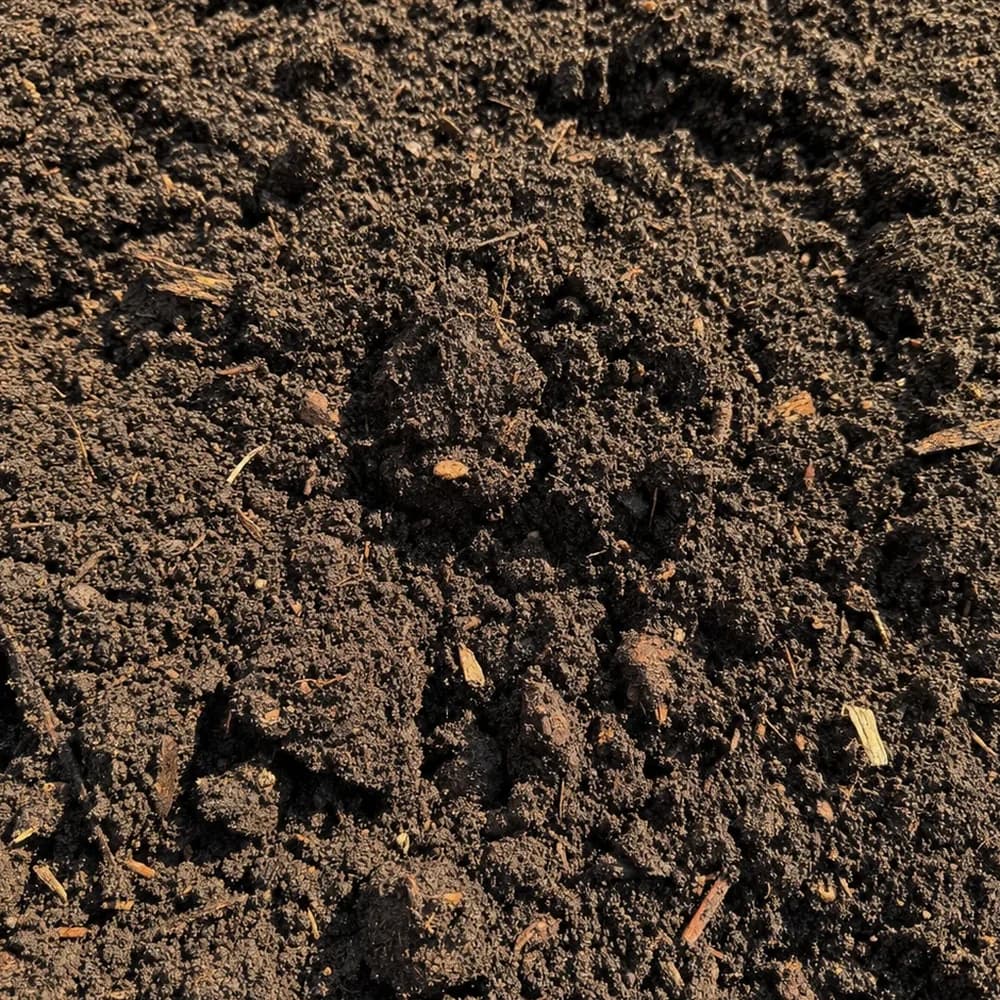
What screened soil looks like once it is raked out
Take a handful from a fresh pile and squeeze it. Good screened soil holds together briefly and then crumbles rather than staying in a dense ball the way raw clay does. There is no stone in it, no root wads and no hard lumps, which is the practical difference you feel the first time you drag a rake across a 20 foot run without stopping to pick something out.
Color runs darker than the orange-red subsoil around it, and a fresh load looks darker still because it holds moisture. It will lighten as it dries, and that is normal rather than a sign the soil has gone off.
The texture matters more than the color. Balanced sand, silt and clay is workable: it takes water in without turning to soup, and it holds enough to get seed or sod through a hot week.
Repairing the scar a turnaround pad or a trench leaves behind
The most common Georgia job for this material is cosmetic repair after construction. A turnaround pad goes in at the end of a drive, and either side of it sits a strip of compacted, rutted clay with no chance of growing grass. Loosen it, bring that strip up to grade with screened soil and it will carry turf.
A French drain along a foundation leaves the same problem in a narrower shape. Once the stone is in and the fabric is folded over, the trench needs a cap of soil to bring it flush with the surrounding lawn and hide the line. Top soil is the right cap, laid over the fabric rather than mixed into the stone.
A low spot in the yard, the place that holds water after every thunderstorm and drowns the grass, is the third. Shallow dips are a soil job. Deep ones are not, which is the next section.
Where it should not go: the drain line and the deep low spot
Screened soil is a finish layer. It is not structural, it is not a drainage material, and it is not a cheap way to move a lot of ground.
Do not put it in a drain trench in place of stone. It holds water rather than carrying it, and a trench packed with soil is just a buried puddle running along a foundation.
Do not use it to fill a hole more than a few inches deep. A yard that needs raising by a foot wants Fill Dirt underneath, compacted in lifts, with soil only as the top few inches. Soil filled deep settles for years and the dip comes back.
And do not expect it to fix drainage. If water is standing because the ground has no fall, adding soil moves the puddle rather than removing it. Shape the grade first so water runs somewhere, then finish with soil.
Depth for sod, for seed and for a shallow regrade
New turf and overseeding want a few inches of workable soil for roots to take hold in, spread over ground that has been loosened rather than laid straight onto slick compacted clay. Running a tiller or a rake through the top of the clay first lets the two layers knit; otherwise the new soil sits on the old like a mat and the roots stop at the boundary.
A shallow regrade is depth-by-eye: string a line, find the difference between the low point and the surround, and spread to suit, feathering the edges so there is no lip. Keep fall away from the house.
Planting a tree or shrub is the exception where less is more. Blending screened soil with the native ground in the planting area works better than a pocket of soft soil in a clay hole, which behaves like a bucket and holds water around the root ball.
Cubic yards for a 30 by 20 lawn patch and a trench cap
Hypothetical examples, worked through so the arithmetic is visible.
A bare lawn patch 30 feet by 20 feet at 3 inches: 30 x 20 x (3 / 12) = 150 cubic feet, and 150 / 27 = 5.56 cubic yards. Order 5.5 or 6.
A French drain cap 40 feet long and 18 inches wide at 3 inches: 40 x 1.5 x (3 / 12) = 15 cubic feet, and 15 / 27 = 0.56 cubic yards. Half a yard covers it.
A low spot 12 feet by 12 feet averaging 4 inches: 12 x 12 x (4 / 12) = 48 cubic feet, and 48 / 27 = 1.78 cubic yards. Round to 2, because soil settles.
These are loose volumes. This site's calculator pages put screened top soil at roughly 2,200 lb per cubic yard, about 1.10 tons per yard, and on that approximate figure the lawn patch is 5.56 x 1.10 = about 6.1 tons, the drain cap 0.56 x 1.10 = about 0.6 tons, and the low spot 1.78 x 1.10 = about 2 tons. Put your own measurements into the Topsoil Calculator to check them.
Plant beds want Garden Soil, low ground wants Fill Dirt
Three soil products sit on this site and they do different jobs. Screened top soil is the general purpose layer for lawns, shallow regrades and bed topping. Garden Soil is the richer mix for raised beds and planting areas where vegetables and perennials are going in. Fill Dirt is bulk material for raising grade and backfilling, and nothing is expected to grow in it.
Once the layer is down, Shredded Mulch over the beds holds moisture through a Georgia summer and keeps a fresh surface from washing in a storm.
To order, measure your area, run the depth through the calculator, then choose a quantity and a delivery date on this page. Delivery is arranged by ZIP code at checkout; check the delivery page for how that works, and have a clear dump spot ready off the grass. If the only route in crosses a lawn you care about, mention it through Contact first.
Quickly Calculate How Much You Need
Material: Top Soil
How to Measure
Measure the length and width of your project area in feet
Decide on depth in inches (2" for landscaping, 4" for driveways)
Enter the values above and we'll calculate the tonnage you need
Need help figuring out the right amount? We can help!
Call or text us at (678) 562-7522 and we'll help you calculate the right quantity for your project.
Not sure how much you need? The Topsoil Calculator has depth guides, coverage charts and worked examples for this material.
Frequently Asked Questions About Top Soil
Customer Reviews
Needed top soil for my yard and these guys delivered quick, fair price and the top soil was just what I needed.
Mike H. · Savannah, GA · Verified Buyer
Decided on them for top soil and I'm really happy with how easy the whole order was. I'd definitely order again and recommend them to anyone needing a delivery.
Lisa D. · Savannah, GA · Verified Buyer
Decided on top soil from them and ordering was painless from start to finish. Delivery showed up as expected, and I'm really happy with how it all turned out.
Nicole P. · Macon, GA · Verified Buyer
Decided on top soil from these guys and the delivery showed up right on schedule. Price was fair too, honestly felt like good value and I'd order again.
Steve W. · Savannah, GA · Verified Buyer
Good start for new grass
I spread this over a reseeded patch of lawn. It was easy to rake out and gave the new grass a good start. It was a practical choice for the job at my Atlanta, GA home.
Hayden W. · Atlanta, GA · Verified Buyer
Top Soil has 5 verified customer reviews with an average rating of 5 out of 5.