Fill Dirt Calculator for Hollows, Trenches and Berms
Enter your project dimensions
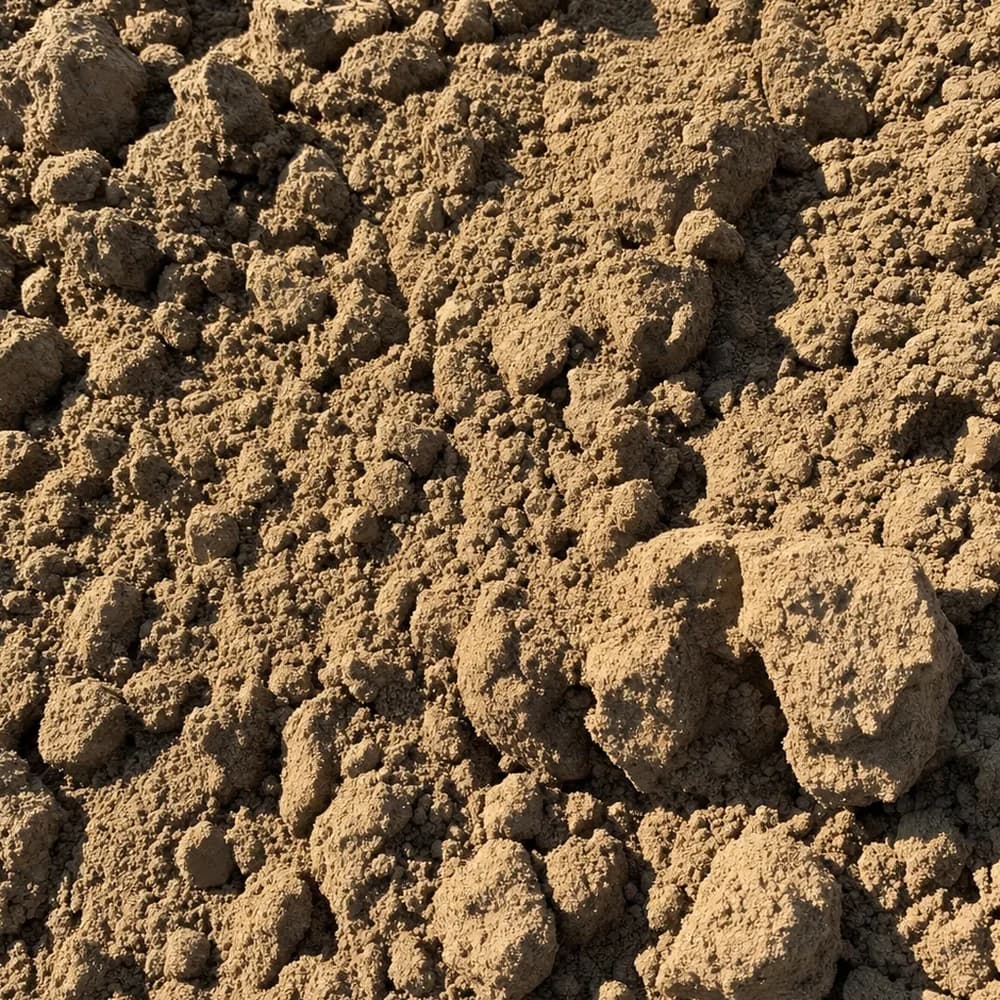
A washed-out hollow in a red clay yard has no flat bottom to measure. It is eight inches down where the water sat and it feathers out to nothing at the edges, which is exactly why people hand-guess this one and end up a load short. The fix is an average, and the second fix is ordering the right material in the first place. Fill dirt is subsoil for holding a grade. It is not the stuff grass roots into, and the two get ordered the wrong way round often enough to be worth settling before you touch the depth box.
Subsoil holds the grade, topsoil grows the grass
Three calculators on this site cover material that all looks like dirt in a pile.
Use this one for structural fill: raising a low corner, backfilling a trench, building a berm, bringing a pad up before the base stone that goes over a finished pad is sized. Fill dirt is screened subsoil with the organic matter and debris taken out, which is what lets it hold a grade instead of rotting down and dropping.
Use the topsoil calculator for the growing layer that goes on top, and the soil calculator when you are ordering bed and border soil for raised beds. A useful habit on a regrade: stop the fill 4 to 6 inches below your finished level, then order Top Soil for the last few inches anywhere grass or plants are going.
Averaging a washed-out hollow in red clay
Measure the length and width in feet as though the hollow were a rectangle that just contains it. Then take the depth at the deepest point and at the shallow edge, and use the middle of the two. Something 8 inches down at the center and 2 at the rim averages 5.
For a trench, the three numbers are honest already: running length, trench width, and the depth of void you are filling above the pipe or the backfilled stone. For a berm, measure the footprint it will cover and use the average height rather than the peak, because the sides fall away from the crown.
Two jobs run through the fields
Both are made-up examples, written out so the arithmetic is visible.
A settled lawn area 20 by 13 feet, averaging 5 inches down, covers 260 square feet. 260 x 5 / 12 = 108.33 cubic feet, which is 4.01 cubic yards. At 1.20 tons a yard that comes to 4.81 tons, or 5.29 with the 10% box ticked.
A utility trench 35 feet long and 2 feet wide with 14 inches of void covers 70 square feet. 70 x 14 / 12 = 81.67 cubic feet, or 3.02 cubic yards. At 1.20 that is 3.63 tons, and 3.99 with the extra 10%.
The trench covers just over a quarter of the lawn area and still takes three quarters as much dirt, because depth is doing the work. That is the number to measure twice.
Running the tool: shape, depth, material, extra
Rectangle takes a length and width in feet. Circle takes a diameter, which suits an old pool or a stump hole. Multiple areas holds up to five separate pieces, so a yard with three sunken spots goes in as one calculation rather than three.
Depth is in inches, from 0.25 up to 24, which means a deep hole gets broken into layers or converted: 3 feet is 36 inches, so run the top 24 and the bottom 12 as two entries and add them. Pick your material, leave the tick box marked add 10% extra for compaction and spillage ticked, or untick it, and the result comes back as cubic yards, tons and cubic feet, with an option to email the figures over.
A yard of dry fill, and the same yard after a storm
Dry fill dirt is about 2,400 lb per cubic yard on this site, which is the 1.20 tons a yard the tool multiplies by. Soak it and the same yard goes up to 3,000 lb, or 1.50 tons. Screened topsoil sits lighter at roughly 2,200 lb, or 1.10.
Rain changes the weight, not the hole. The yardage you ordered is still the yardage you need after a Georgia downpour, so do not re-run the numbers because the pile got heavier. What does change is the work: saturated red clay smears under a tamper rather than packing, and a wheelbarrow that took two scoops dry takes one wet. Order for the volume, then pick your window.
Lifts, settling, and the second load nobody wants to order
Place fill in 6 to 8 inch lifts and compact each one before the next goes on. Without a plate or a tamper, soak each lift well and give it time to settle. On a lawn repair, finish about half an inch proud of the surrounding grade and let it drop level.
The 10% cushion covers spillage and the low spot that reads deeper than the tape suggested. It does not cover long-term settlement, which is why lifts matter more than the tick box. Keep wood, roots and yard debris out of the fill entirely: buried organic matter breaks down and leaves you a fresh depression years later, and anything carrying load needs a compaction spec from an engineer rather than a calculator.
A berm built to turn storm runoff
Say a berm to steer runoff away from a shed footprint covers 22 by 6 feet and stands about 24 inches at the crown. A berm is a triangle in cross section, so the average across the footprint is 12 inches. That is 132 square feet, and 132 x 12 / 12 = 132 cubic feet, or 4.89 cubic yards. At 1.20 tons a yard that is 5.87 tons, or 6.46 with the 10%. The same 4.89 yards of wet fill would ride in at 7.33 tons, which matters to the truck and to your back, not to the order.
Cap a berm like that with a few inches of topsoil and seed it, or the first Piedmont thunderstorm will carve the bare clay straight back off it. When your yardage looks right, open Fill Dirt to set quantity and date, and leave the truck a firm, clear spot to tip on; how delivery works covers what the driver is looking for. Delivery is arranged at checkout by ZIP code.
Common questions
Can I check the tool's answer on a phone calculator?
Yes, and it is worth doing once. Multiply length by width in feet, multiply by the depth in inches, divide by 12, then divide by 27. That is your cubic yards. Multiply by 1.20 for tons of dry fill. The 20 by 13 example above lands on 4.01 yards either way.
Why does the topsoil tool show fewer tons than this one for the same hole?
Because the two materials weigh differently. Topsoil runs about 2,200 lb a cubic yard against 2,400 for dry fill dirt, so the same volume prices out lighter. The yardage is identical; only the ton line moves.
Should I leave the 10 percent ticked on fill that is going to settle anyway?
Leave it ticked, but do not count on it. Ten percent is a spillage margin. Settlement is handled by placing the material in 6 to 8 inch lifts and compacting as you go, and on a lawn by finishing slightly high and letting it drop.
The low spot runs away downhill. Where do I take the depth?
Take it in at least three places along the fall, including the deepest point, and average them. Measure the length along the slope rather than across the flat, since that is the surface the dirt has to cover.
The area wraps around the corner of the house. Do I split it up?
Use multiple areas and enter each leg as its own rectangle, meeting but not overlapping at the corner. Give each leg its own average depth, because a strip against a foundation is usually shallower than the open yard beyond it.
Related calculators
Cheap by the yard, free to your gate.
Screened fill dirt for grading and backfill, delivered across Georgia.