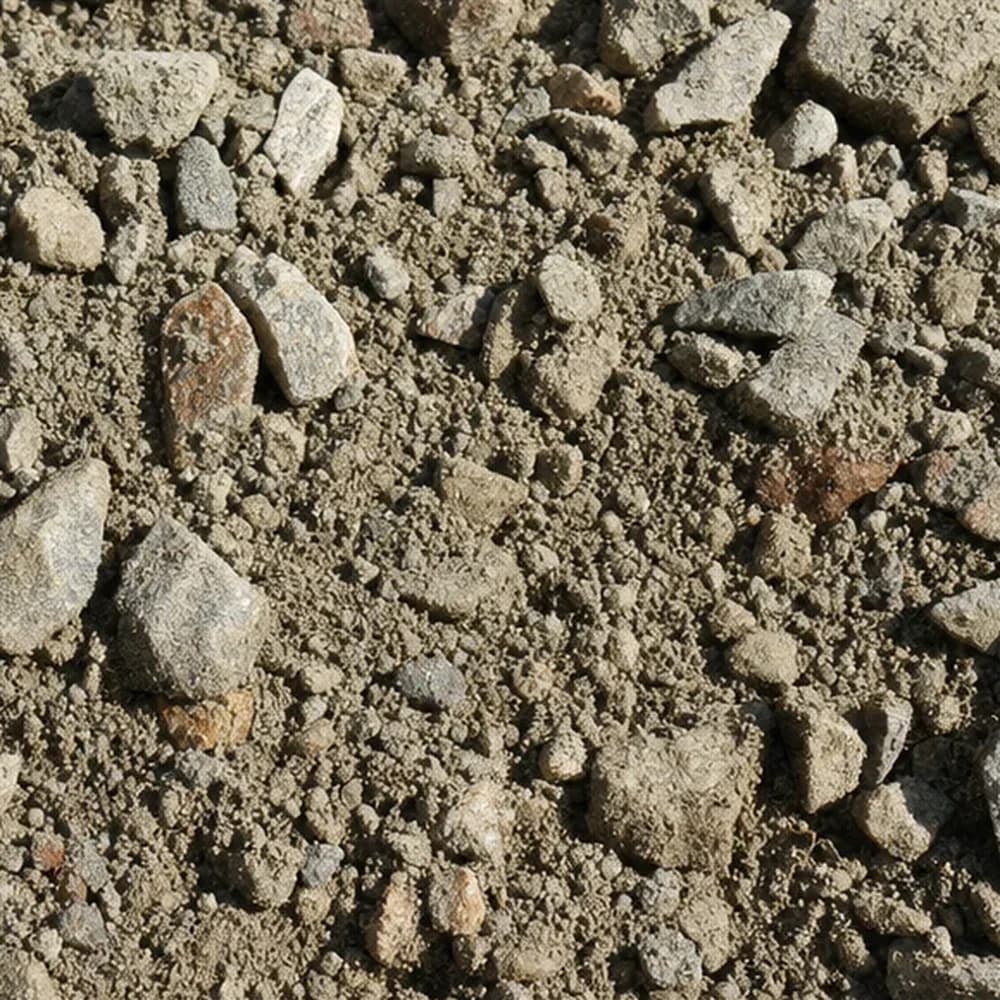
Crusher Run Calculator: Compacted Tons for Lanes and Pads
Enter your project dimensions
Two base jobs can sit thirty feet apart on the same Piedmont lot and land nowhere near each other on the ticket. A short walkway base takes around three tons. A pad the work trailer parks on takes eight. The slip this crusher run calculator has to correct most often is the depth box: people type in the depth they dug out, or the height they want the pile to reach, when the figure that belongs there is the thickness of the layer after it has been rolled flat. Get that one number honest and everything after it is arithmetic.
A walkway base and a trailer pad, five tons apart
Both of these are made-up jobs, written out so you can follow the math.
A garden walkway 40 feet long and 4 feet wide, based at 4 inches compacted, covers 160 square feet. 160 x 4 / 12 = 53.33 cubic feet, which is 1.98 cubic yards. At 1.50 tons a yard that comes to 2.96 tons, or 3.26 tons with the 10% box ticked.
A parking pad 24 by 12 feet at 6 inches covers 288 square feet. 288 x 6 / 12 = 144 cubic feet, or 5.33 cubic yards. At 1.50 that is 8.00 tons, and 8.80 tons with the extra 10%.
Same material, same yard. Two inches of extra depth and a bigger footprint, and the second load is nearly three times the first. Depth moves the total faster than anything else you type.
Picking the thickness the traffic actually calls for
Four inches compacted is the working figure under walkways and paver work. Four to six suits a car drive. Six to eight is what you want where a loaded truck turns or a trailer gets parked. Shed and hot tub pads take four inches once turf and soft topsoil are stripped, and six where the ground under them gives. Red clay that has held rain for a week counts as soft ground, whatever it felt like underfoot in August.
Where the base is doing structural work over Piedmont clay, put the extra thickness in the stone rather than in a deeper sand or screening layer above it. Fines-rich stone is what stiffens up under the plate; loose material above it only follows whatever the base does.
Entering a lane or a pad one field at a time
Pick the shape first. Rectangle takes a length and a width in feet, so a lane is its running length by its finished width. Circle takes a diameter in feet, handy for a round hot tub pad. Multiple areas lets you add as many as five pieces, which covers a drive with a turnaround off the side.
Depth goes in next, in inches, anywhere from 0.25 to 24. Choose the material, leave the tick box marked add 10% extra for compaction and spillage ticked, or untick it, then press the button. Cubic yards, tons and cubic feet come back together, and there is an email option under the result if you want the figures sent over rather than copied down.
What the 10 percent covers, and what it does not
Crush and run tightens as you roll it, losing somewhere around 10 to 15 percent of its loose height. That is not waste, it is the material doing its job, and it is the reason the number in the depth box should be the finished compacted thickness rather than the loose spread. Enter four inches and expect the raw stone to sit noticeably proud before the plate goes over it.
The 10% option is a different thing: a cushion for what misses the pad, what the wheelbarrow spills across the grass, and the low corner that turns out deeper than the tape said. Leave it ticked on any base you are compacting. Keep a wheelbarrow load back at the end, too, because a drive over clay usually wants a touch-up somewhere in the first season.
What the fines add to a yard of crush and run
A cubic yard is 27 cubic feet, whatever is in it. Crusher run and graded aggregate base run about 3,000 lb per cubic yard on this site, which is the 1.50 tons a yard the tool multiplies by. The fines that pack into the gaps between stones are what make it heavier than clean stone: #57 granite and 3/4" crushed stone come in around 2,800 lb, or 1.40 tons a yard, on the same arithmetic.
So a yard of hole is a yard of hole, but the ton line changes with the material you select. That is worth knowing before you compare your figure with a neighbor's.
GAB, crush and run, and the stone that goes on top
The base material most Georgia plans call for is graded aggregate base, written GAB on a ticket and specified by GDOT under Section 815. Crushed stone with fines left in, sold here as Crusher Run and as GAB (Graded Aggregate Base), is the same family and carries the same 1.50 figure.
What it should not do is drainage. The fines that let it bind also hold water, so a French drain or a run behind a wall wants clean stone instead: #57 granite or drain rock, with nothing in the mix to clog. On a rural lane, crush and run alone gives a usable surface that wants regrading every few years, and a 2 to 3 inch layer of driveway gravel over the compacted base handles dust and gives the drive a finished top.
Two calculators, one material: which page to open
This site also has a road base calculator, and what separates the two is the job rather than the arithmetic. Open this one when you are buying the binding stone by the ton for a lane, a pad or a rural drive. Open the road base page when you are sizing the base course under a longer drive and want the discussion framed that way, and open the paver base calculator when the base has to reach past the edge of the pavers and you need a dig depth as well as a tonnage.
Once the figure settles, open the product page for the material you chose and set your quantity and date there. Delivery is arranged at checkout by ZIP code, so pick a dump spot the truck can back to on firm ground.
Common questions
My neighbor entered the same 4 inches and got a completely different tonnage. What changed?
The material select. Volume is identical, weight is not. At 1.50 tons a yard, crush and run is five times heavier per yard than shredded mulch at 0.30, and a little heavier than clean #57 granite at 1.40. Check which material was selected before you check the tape.
Is 10 percent enough on a base I am going to compact?
For spillage and an uneven subgrade, yes. It is not a compaction correction, because the depth you enter should already be the rolled thickness. If the ground under the pad is soft clay, the honest fix is another inch or two of depth in the box, not a bigger percentage.
The pad runs downhill. Do I measure the slope or the flat footprint?
Measure along the ground you are covering, following the fall rather than sighting across it. On a lane with any real grade, that adds a foot or two of length, and it is also the stretch where washed-out stone will need topping up first.
My parking pad is an L around the corner of the garage. Do I run it twice?
Use multiple areas and enter it as two rectangles that meet at the corner, with no overlap between them. The tool totals as many as five pieces, so a drive with a turnaround goes in as one calculation.
Does the timber edging strip count as part of the width?
Only if stone goes under it. Edging set on top of the compacted base sits inside your measurement; edging bedded on its own trench does not, and that trench is small enough to come out of the 10 percent cushion.
Related calculators
Base tonnage sorted? Good.
Crusher run by the ton, the cheapest structure on the yard, delivered free.