Soil Calculator for Raised Beds and Tired Borders
Enter your project dimensions
Look at a bed that has been planted a few seasons and you can usually see the answer to the first question: the soil sits an inch or two below the top board, and there is a clean line on the timber showing where it used to be. That gap, times the area inside the frame, is the order. Everything below turns what you can see into cubic yards.
Filling beds in the cool months, before the planting rush
Bed work here is comfortable from late fall through the end of winter, when the ground is workable, the wet spells pass through quickly and nothing is growing that a wheelbarrow would flatten. Beds filled then have time to settle and soak before spring planting, which matters more than it sounds: freshly delivered blend drops noticeably in its first few weeks.
Later in the year the limit is not the calendar but the clay. After a long wet spell the yard will not take a wheelbarrow without leaving ruts, and a bulk load tipped on saturated ground is a mess to move. Put the order in for a week that looks dry and give yourself two days.
Reading a bed that has sunk below its top board
Measure inside the frame, not across the timber, since the boards are not getting filled. Length and width both in feet, both in decimals.
For depth, drop a straightedge across the frame and measure down to the soil in three or four places, then use the middle figure rather than the worst spot. An empty planter is easier: it is the inside height you intend to fill, less an inch of freeboard so the first watering does not wash blend over the edge. For an in-ground border you are improving rather than replacing, the depth is the layer you will work in, usually 2 to 3 inches, not the full depth of the bed.
Three beds and a planter in one pass
Rectangle takes a length and a width in feet, which covers almost every bed built out of boards. Circle takes a diameter, for a round planter or a ring bed cut into the lawn. Multiple areas holds up to five separate pieces, so three beds of different sizes go in as one calculation and come back as one figure.
Depth is entered in inches, from 0.25 to 24. Pick the blend from the material list, decide on the box marked add 5% extra for compaction and spillage, and the result appears as cubic yards, tons and cubic feet, with an option underneath to have it emailed.
Cubic yards on the order, and what a yard of each blend weighs
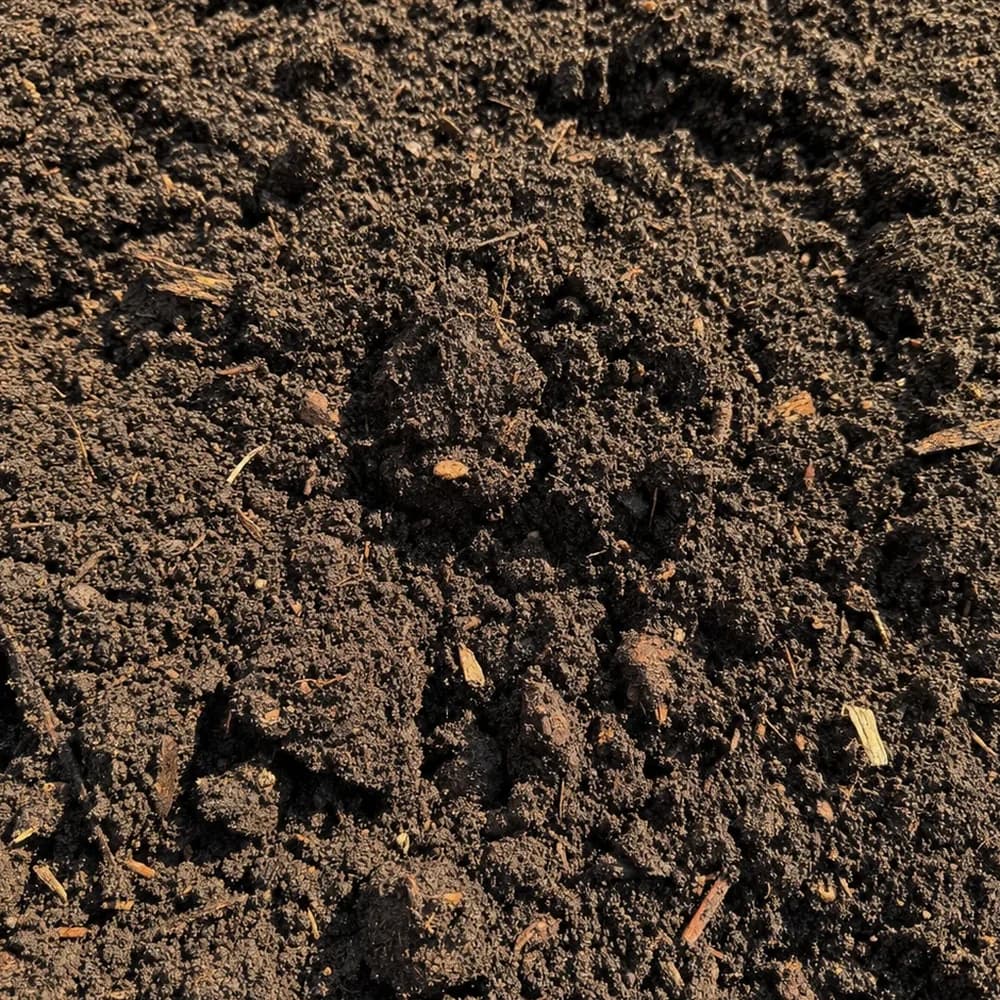
Soil is ordered by volume here, which is why the cubic yard figure is the one to write down. The tons line is there because it tells you what is arriving on the truck, and the material select is what sets it: garden soil blended with compost runs about 2,000 lb a cubic yard, which is 1.00 tons; screened topsoil about 2,200 lb, or 1.10; fill dirt about 2,400 lb, or 1.20.
The volume never moves between them. Length times width in feet, times depth in inches, divided by 12 for cubic feet, divided by 27 for cubic yards. Only the last multiplication changes, so a bed that takes 4.74 yards takes 4.74 yards whichever of the three you choose, and only the weight on the ticket shifts.
Fill depths for new beds, tired beds and tall planters
An empty raised bed gets filled to its working depth, which is 12 inches for most vegetable boxes. A new in-ground bed cut into red clay wants about 6 inches of blend worked into the loosened ground beneath rather than laid on top of it, because roots stall at a sharp line between imported soil and unbroken clay. A bed that has simply gone tired takes 2 to 3 inches turned through the top 6, which is a fraction of the material and most of the benefit.
Anything taller than about 18 inches does not need blend from the boards down. Put the lower part in Fill Dirt or coarse organic matter that will break down in place, then 8 to 12 inches of Garden Soil where the roots live, and run the tool twice, once for each layer.
Worked through, with made-up dimensions: two beds at 4 by 12 feet and one at 4 by 8, all filled 12 inches deep. That is 48 plus 48 plus 32, or 128 square feet. 128 x 12 / 12 = 128 cubic feet, which is 4.74 cubic yards, or 4.74 tons of garden soil, and 4.98 yards with the 5% box ticked.
A tall planter 5 by 3 feet and 24 inches deep, split in two: the bottom 14 inches is 15 x 14 / 12 = 17.5 cubic feet, or 0.65 cubic yards of fill dirt, which is 0.78 tons. The top 10 inches is 12.5 cubic feet, or 0.46 cubic yards of garden soil at 0.46 tons.
Beds on this page, turf on the topsoil page
The split between the tools is the job, not the product name, and picking the right one saves an order.
Stay here for anything being planted into: beds, borders and planters. Lawns, seeding and finish grade go to the topsoil calculator, and structural fill to the dirt calculator: raising a low corner, backfilling, bringing a pad up. A useful habit on any regrade is to stop the fill short and keep the last few inches for something roots can live in.
Settling, and the extra yard that tops the beds back up
Tick the 5% box, then expect to want a little more anyway. Compost-rich blend consolidates as it wets and works down, commonly around a tenth of its depth in the first few weeks and more in a deep planter. That is not a fault in the order; it is organic matter finding its level.
Fill a bed slightly above the rim, water it hard, and top it back up once before planting. Keep whatever is left under a tarp for spring, because densely planted beds usually ask for an inch or two every year. When your yardage looks right, open the product page to pick quantity and a date. Delivery is arranged at checkout by ZIP code, and booking the drop covers what the truck needs; it is worth laying a tarp on the drive, since bulk soil marks concrete. Mulch for the finished bed is a separate order on its own tool.
Common questions
The bed runs down one side of the drive and turns along the fence. One entry or two?
Two entries, one calculation. Switch to multiple areas and enter each leg as its own rectangle, meeting but not overlapping where they turn the corner. One depth applies to the whole run, so if one leg is deeper, run it separately and add the two yardages together.
The bed is ringed with stacked block. Which face do I take the width from?
The inside face, at the height the soil will reach. Block walls lean in slightly as they are stacked, so measure at the top rather than at ground level, where the opening is wider and the figure will run you long.
Can I put cheaper material in the bottom of a deep planter?
In anything over about 18 inches, yes. Fill the lower part with fill dirt or coarse organic matter and keep 8 to 12 inches of blend at the top. Run the two layers as separate calculations, because they take different depths and different weights per yard.
The front border is one long curve with no square corner. What do I enter?
Straighten it on paper. Take the length along the middle of the curve as if it were pulled flat, measure the width in several places and average it, then enter that rectangle. On a border of a yard or two the rounding disappears inside the 5% box.
The beds only need a few inches of fresh soil on top. What depth is that?
Whatever you measured down from the straightedge, and usually 2 to 3 inches. Enter that, not the full depth of the bed. As an example, 220 square feet of tired border at 3 inches is 55 cubic feet, or 2.04 cubic yards, which is 2.04 tons of garden soil and 2.24 tons if you order the same volume as screened Top Soil.
Related calculators
Beds measured? Soil's a click away.
Garden soil, topsoil and fill dirt by the yard, free delivery included.