Rip Rap Calculator: Tons for a Bank, Measured Up the Slope
Enter your project dimensions
The decision in front of most people on this page is not how many tons. It is how big a stone and how thick a course, because those two choices set the tonnage and everything else follows. A creek that runs brown and fast for an hour after a Georgia thunderstorm, chewing at a bare clay bank, needs something different from a downspout outlet that trickles. Work the job through in the order it happens and the calculator does its part near the end.
Reading the water before you choose a stone size
Start with what the bank actually faces. Slow water at a pond edge, a downspout run or a small stream is the case for stone in the 4 to 8 inch range. A lake edge taking boat wake, or a channel that moves hard after a storm, wants 8 to 12 inch stone. Between two sizes, take the bigger one and the thicker course: weight is the whole mechanism, and heavier stone gives you tolerance you cannot add later. If the water is hard to read from the bank, ask before ordering.
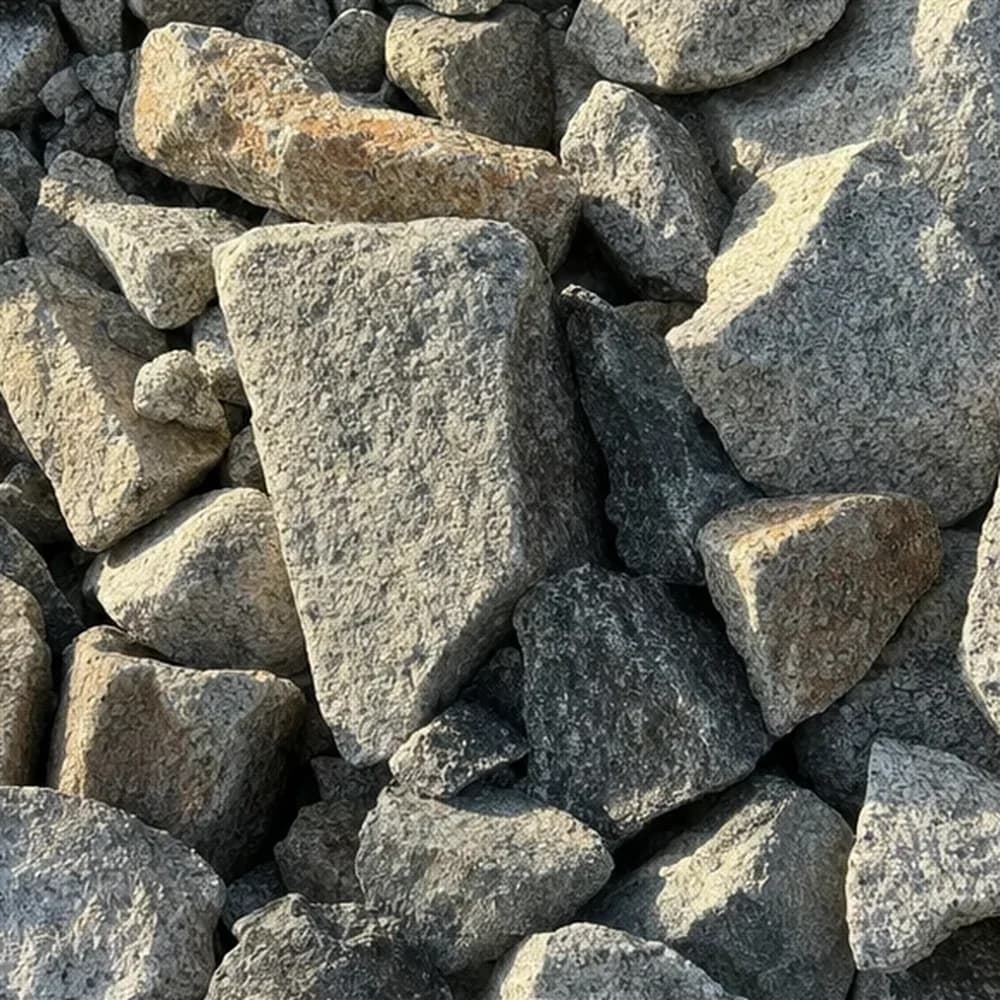
Locally you will hear this material called stone rip rap, specified by GDOT as Type 1 or Type 3 by size, and some suppliers call the largest granite pieces surge stone. Sold here it is RipRap. Anything engineered, a highway slope or a spillway, comes with its own specified size and depth on the drawing, and that drawing wins over any guidance on this page.
Shaping the bank and locking the toe
Cut the bank back to 2:1 or flatter before a stone lands on it. Steeper than that is an engineering problem, not a stone problem, and no extra tonnage will fix it.
Then plan the bottom. The lowest stones go below the waterline or below the depth you expect scour to reach, because that is where failures start. Water undercuts the toe, the course above slumps into the hole, and the bank you armored ends up in the creek. Lock the toe first and the rest of the face has something to rest on.
Approval comes before stone. Check with your state and local authorities before anything goes in below the ordinary high water line of a creek, pond or lake. Placing rock in and along a watercourse is commonly permitted work, what is required varies with the waterbody, and this page cannot answer it for you.
Bedding on red clay, so the stone stays put
Bare clay will hold for a season and then wash out from under the rock. Put non-woven geotextile down first, which means a trip to a landscape supplier because it is not sold here, or lay 3 to 4 inches of #4 Crushed Stone as a bedding course. On a Piedmont cut bank that has already lost its topsoil, the fabric is cheap next to relaying the stone.
For a culvert outlet, run the apron 4 to 6 pipe diameters past the end of the pipe. An 18 inch pipe means 6 to 9 feet of armored ground beyond the outlet, which is the stretch the water scours first.
Measuring the face, not the footprint
This is where riprap quantities go wrong. Measure up the slope, along the face the stone will cover, rather than across the flat ground in plan view. On a bank with any real steepness the face is meaningfully longer than the horizontal distance, and that difference is tons.
Layer thickness is the other number. Make the course 1.5 to 2 times the largest stone dimension, and do not go below 12 inches whatever the stone size suggests. Typical residential stone at 4 to 12 inches lands at a 12 to 18 inch course. Large rock or fast water calls for 24, which is also the deepest the depth box accepts.
Turning 60 feet of creek bank into tons
A made-up job, written out so the working is visible. Sixty feet of bank with a face measuring 4.5 feet from toe to top is 270 square feet of slope. At a 15 inch course: 270 x 15 / 12 = 337.5 cubic feet, which is 12.50 cubic yards. At 1.55 tons a yard that comes to 19.38 tons, or 20.34 with the 5% box ticked. Order 20 tons and a bit.
Bedding for the same face at 4 inches of #4 stone: 270 x 4 / 12 = 90 cubic feet, or 3.33 cubic yards. At 1.45 tons a yard that is 4.83 tons.
A smaller job for comparison. An apron at a culvert outlet, 10 feet out by 7 feet wide at a 12 inch course, covers 70 square feet: 70 x 12 / 12 = 70 cubic feet, 2.59 cubic yards, 4.02 tons. Different job, a fifth of the tonnage, same arithmetic.
To run your own: choose rectangle and enter the face length and its slope height in feet, or use multiple areas for a bank that changes height along its length, entering each stretch with its own face measurement. Depth is in inches. Select the material, decide on the tick box marked add 5% extra for compaction and spillage, and read the cubic yards, tons and cubic feet that come back, with the option to email them over.
Placing stone, then walking the bank after the first storm
Set the face rather than tipping it. Fit stones against each other, larger pieces at the toe and at the bends where the current drives hardest. Hand placing is realistic up to about 6 to 8 inches of stone, and past that size it is machine work.
After the first heavy rain, once the water drops, walk the length of it. Look for stone that has moved at the toe, soil showing between rocks, fabric on display, and scour digging in past the end of the apron. Reset what shifted and fill the thin patches from the stone you held back. That short walk twice a year is the whole maintenance program.
Why armor stone runs 3,100 lb to the yard
Riprap weighs about 3,100 lb per cubic yard on this site, or 1.55 tons, the heaviest figure in the catalogue. Crushed stone is around 2,800 lb and shredded mulch about 600, in the same 27 cubic feet.
That weight is also why coverage looks so poor. One ton is roughly 0.65 cubic yards, about 17 cubic feet, which spread at a 12 inch course covers only about 17 square feet of bank. The same ton spread two inches deep as landscape rock covers well over a hundred square feet. The pile that gets delivered always looks small next to the bank it has to hold, and it is not.
A dry creek bed that only runs after a storm and is meant to look like water is decorative work instead: size it on the river rock calculator and buy Large River Rock, which moving water rolls away.
Before you order, walk the route the truck will take. Loaded trucks bog down in the last stretch to a creek or a pond edge, and moving stone twice is the one avoidable cost on this job. Delivery is arranged at checkout by ZIP code, and quantity and date are set on the product page.
Common questions
Part of my bank is still good and only the middle needs more stone. How do I size that?
Measure only the stretch that is thin, and enter the depth you are adding rather than the finished course. If the existing stone is 8 inches and you want 15, enter 7. Where the old stone has slumped away entirely, treat that stretch as new work and use the full thickness.
If I come up two or three tons shy, can I just spread it thinner?
You end up spreading the course thinner than planned to make it reach, which is the failure mode this material has. A thin patch at the toe or in a bend is where the next storm starts pulling stone out. Short is worse here than long, and leftover armor stone always finds a use at a downspout or a washout.
Is a tape measure on a rough bank good enough for a 20 ton order?
Close on volume, less exact than a patio job. Stone this size does not pack uniformly, a bank is never a flat plane, and the face measurement is taken by tape on rough ground. Treat the result as the order figure, keep the 5 percent on, and expect to place the last ton by judgment.
Once the tons are settled, what do I actually add to the cart?
The RipRap page for the armor stone, and the #4 Crushed Stone page if you are bedding on stone instead of fabric. Order both together so the bedding course is on site before the big stone arrives.
Where should the stone be dropped?
As near the bank as firm ground allows, on the uphill side, so you are moving stone downhill rather than up. Twenty tons is a substantial pile and will kill grass under it, so pick a spot you do not mind scarring, and keep the drop clear of the route you will be wheelbarrowing or tracking along.
Related calculators
Banks don't armor themselves.
RipRap by the ton with free delivery, plus the #4 bedding stone to go under it.