River Rock Calculator: Bed Area, Depth and Tons
Enter your project dimensions
Rain off a Piedmont roof lands hard, and the bare strip of red clay under the eaves is what sends most people looking for river rock in the first place. The questions below come in the order they usually get asked, and the calculator at the top of this page settles all of them once there is a tape in your hand.
What do I measure on a bed that follows the drip line?
Rectangle wants a length and a width in feet. A strip along the front of the house is its running length by its finished width, measured out to the edging rather than to where the grass is currently losing the argument. Circle wants a diameter in feet, which suits a ring under a tree or a splash pad at the bottom of a downspout. Multiple areas holds up to five separate pieces, so a strip down the side of the house plus two beds by the drive goes in as one calculation.
Beds here rarely have square corners. Take the longest run for the length, take the width in three or four places and use the middle figure, and write both down in decimal feet: a bed 11 feet 6 inches across is 11.5, not 11.6.
How deep does the stone have to sit before fabric stops showing?
The working rule is a layer about twice the width of the stone. Three-quarter to one inch stone wants 2 inches. One to three inch stone wants 3, and often 4 at a bed edge where feet and mower wheels push it aside. Larger pieces want 4 to 5. Depth goes in the box in inches, anywhere from 0.25 to 24.
Fabric peeping through a finished bed almost always means the layer went in thin, not that the load came up short. Against a foundation, 3 to 4 inches over non-woven fabric, pitched gently away from the wall, gives roof water somewhere to run and keeps clay from splashing up the brick. Where the bed is carrying real drainage rather than decorating, the fabric goes around the stone instead of under it, or the fines washing off the clay will silt the voids closed.
Why does a ton of river rock look like such a small pile?
Rounded river stone runs about 2,700 lb to the cubic yard on this site, which is the 1.35 tons a yard the tool multiplies by. Turn that round and one ton is roughly three-quarters of a cubic yard, so a delivered ton is a smaller heap than most people picture.
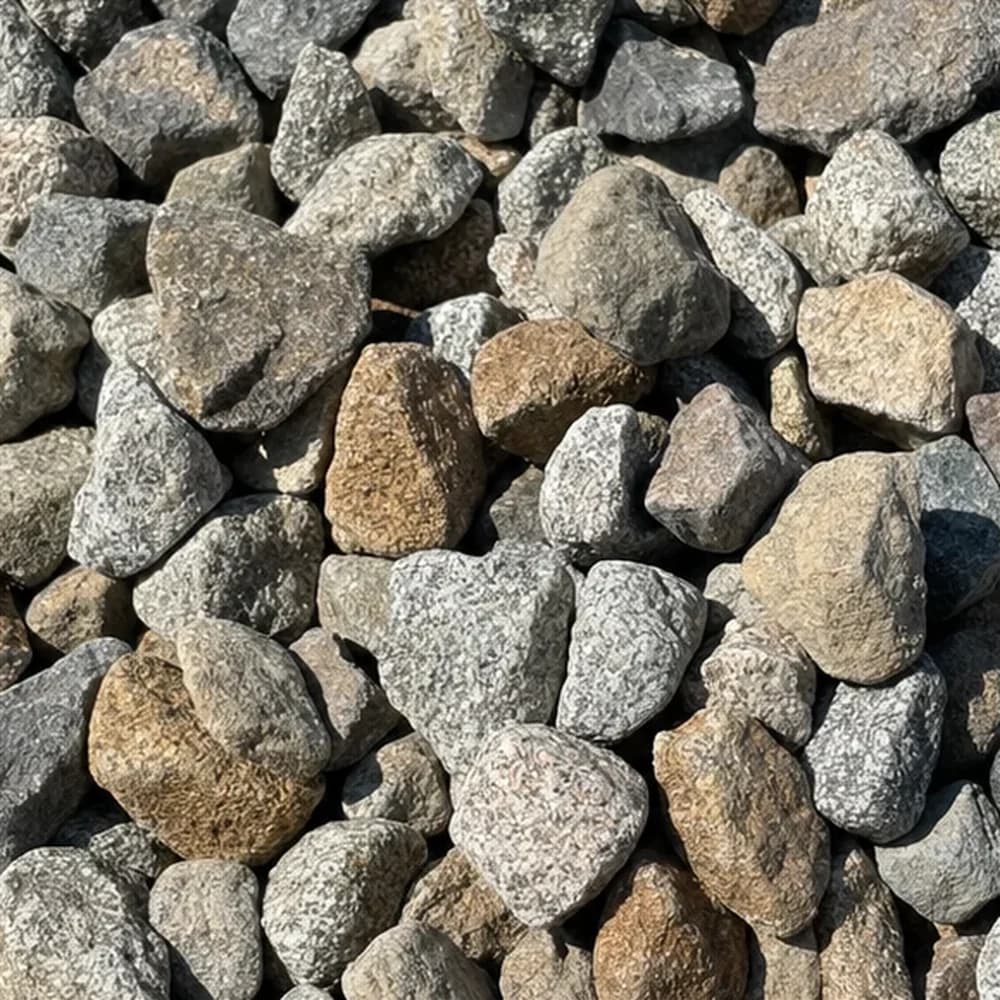
The arithmetic behind the result is short enough to repeat at the tailgate. Length times width in feet gives square feet. Multiply by the depth in inches, divide by 12, and you have cubic feet. Divide by 27 for cubic yards. Multiply by 1.35 for tons. Swap the material and only that last figure moves: angular crushed stone comes in nearer 2,800 lb, or 1.40 tons a yard, and a binding base mix nearer 3,000 lb, or 1.50.
What do a foundation strip and a tree ring come to in tons?
Both of these are made-up jobs, written out so the math is visible.
A strip along the front of the house, 38 feet long and 3.5 feet wide, filled with one to three inch stone at 3 inches. That is 133 square feet. 133 x 3 / 12 = 33.25 cubic feet, which is 1.23 cubic yards. At 1.35 tons a yard it comes to 1.66 tons, or 1.75 with the 5% box ticked.
A ring under a tree, 9 feet across, same stone at the same 3 inches. Circle mode works out the area as 63.6 square feet. 63.6 x 3 / 12 = 15.9 cubic feet, or 0.59 cubic yards, which is 0.80 tons.
Two beds that feel similar standing in the yard, and the strip takes double the stone. Length is doing that, so measure it twice.
Is the 5 percent box worth ticking on a decorative bed?
Tick it. Nothing here gets compacted, so the 5% is not a settlement correction. It is the honest allowance for stone that rolls into the lawn while you are wheelbarrowing, the low corner that turns out an inch deeper than the tape said, and the handful that ends up in the shrub bed next door.
Keep the remainder rather than spreading it thin. The front edge of a bed is where the layer goes shallow first, and a second delivery for half a ton is nobody's idea of a good afternoon.
River rock, large river rock or drain rock: which one do I select?
Three rounded products cover most of this work, and the material list is where you tell the tool which weight to use.
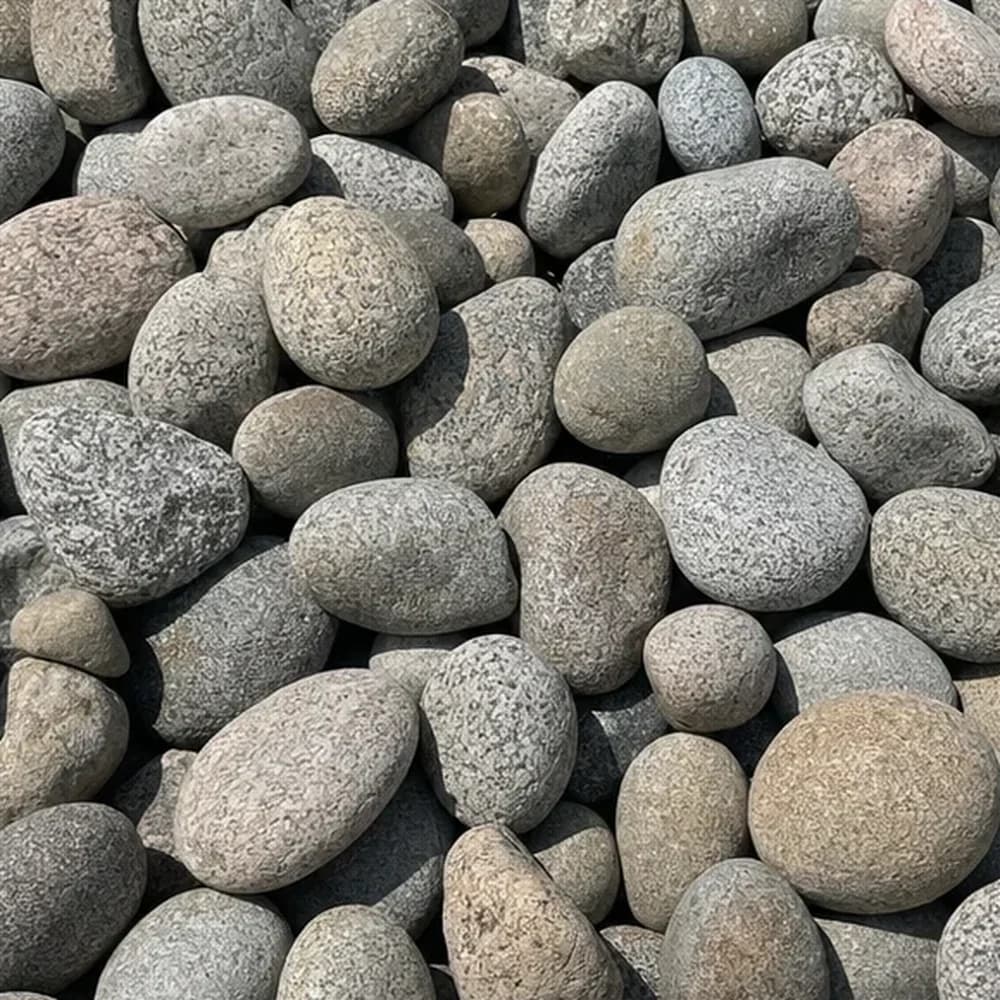
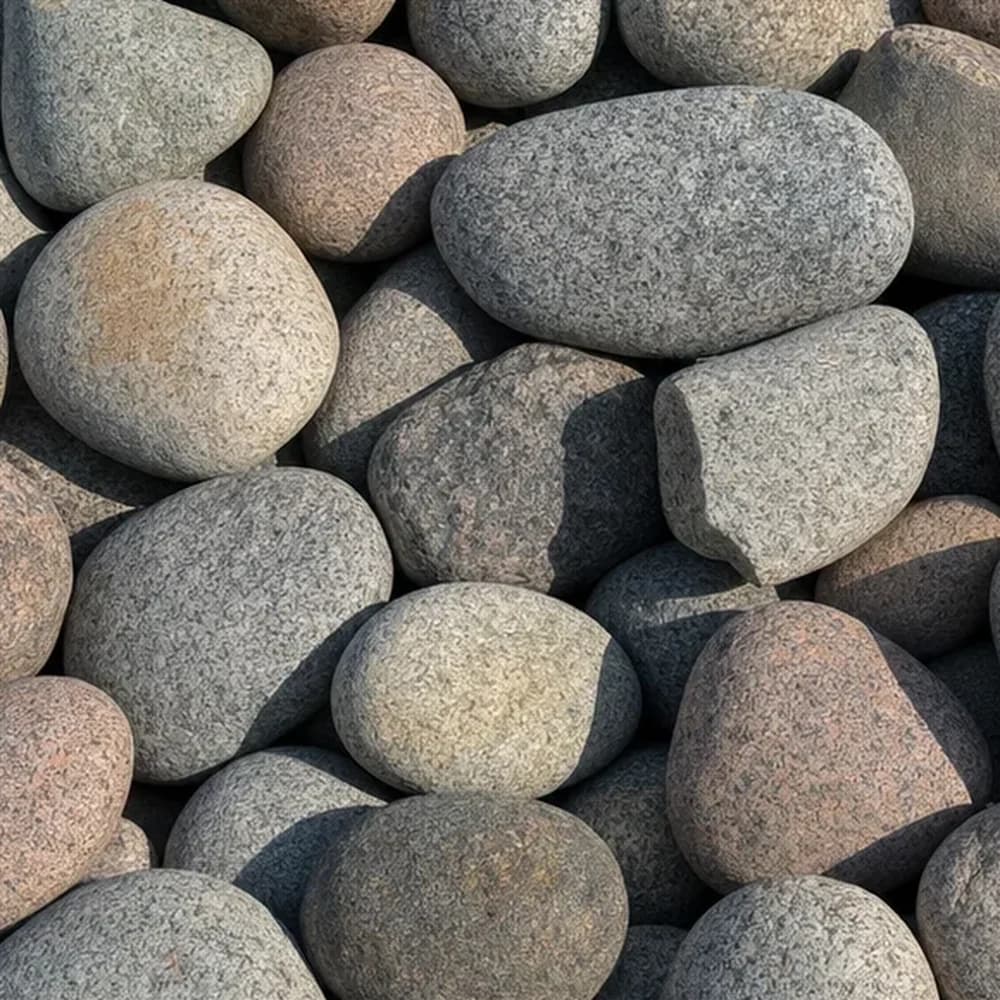
River Rock in the one to three inch range is the everyday bed, border and splash-zone stone. Large River Rock, sold locally as river slicks, is what goes in a dry creek line and along a bed edge where storm runoff would move smaller pieces; set the biggest stones a third of their depth into the clay so they read as water-placed rather than tipped. Drain Rock is the pick where the channel has a job to do, since it is graded for water rather than for looks.
If the pile you have in mind is smaller and rounded, the pea gravel calculator covers 3/8 inch stone at its own depth, and the stone calculator handles the angular graded sizes. Once your tonnage looks right, open the product page to set quantity and date. Delivery is arranged at checkout by ZIP code, so pick a dump spot on firm ground that the truck can back to without crossing soaked clay, which is what how a bulk load is dropped sets out.
Common questions
Is the depth I type the pile as it lands or the bed after it settles?
The bed as you want to see it. River rock is not compacted, and rounded stone only beds down about a quarter of an inch as the pieces find their places. Enter the finished layer, which for one to three inch stone is usually 3 inches.
The bed is a circle around a young maple. What number is the diameter?
Measure straight across the widest part of the finished ring, trunk included. The tool has no way to take a trunk out, and on a young tree that overlap is smaller than the rounding on the tape. Around a mature trunk, run the trunk as a second small circle and take its yardage off by hand.
I would rather do the arithmetic myself. What order does it go in?
Square feet first, then depth in inches divided by 12 for cubic feet, then divide by 27 for cubic yards, then multiply by 1.35 for tons of river rock. The 38 by 3.5 foot strip above lands on 1.23 yards either way.
The same bed came out heavier when I picked crushed stone. What changed?
Only the weight per yard. The hole is the hole: 1.23 cubic yards stays 1.23 cubic yards. River rock is figured at 1.35 tons a yard and crushed stone at 1.40, so the ton line rises even though nothing about the bed moved.
Will 5 percent cover the stone that ends up in the lawn?
On a bed of a couple of tons, yes, with a little left over for the front edge. On anything under a ton the percentage is smaller than a wheelbarrow, so round the order up instead of relying on it.
Related calculators
Rock beds are a one-time buy.
River rock, large river rock and drain rock by the ton, free delivery included.